

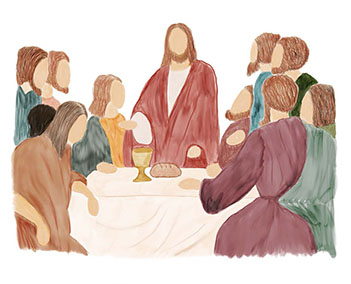
Visit Tribe of Many Arrows on Etsy. These images are used with their permission,
and I am grateful for these beautiful creations accompanying my reflections this month.
Today, we look at the fifth Luminous Mystery of the Rosary: Institution of the Eucharist. The gift of Jesus giving Himself physically so that He can remain with us not just spiritually but physically as well. In recent years, I have developed such a love of Jesus in the Eucharist. His gift of self over and over again is so profound and is a constant lesson in how He expects us to give.
“While they were eating, Jesus took bread, said the blessing, broke it, and giving it to his disciples said, “Take and eat; this is my body.” Then he took a cup, gave thanks, and gave it to them saying, “Drink from it, all of you, for this is my blood of the covenant, which will be shed on behalf of many for the forgiveness of sins. I tell you, from now on I shall not drink this fruit of the wine until the day when I drink it with you new in the kingdom of my Father.” Then singing a hymn, they went out to the Mount of Olives. Matthew 26:26-30 (NABRE)
“I am the bread of life. Your anscestors ate manna in the desert but they died; this is the bread that comes down from heaven so that one may eat it and not die. I am the living bread came down from heaven; whoever eats this bread will live forever; and the bread that I will give is my flesh for the life of the world.
The Jews quarreled among themselves, saying, “How can this man give us [his] flesh to eat?” Jesus said to them, “Amen, amen, I say to you, unless you eat the flesh of the Son of Man and drink his blood, you do not have life within you. Whoever eats my flesh and drinks my blood has eternal life, and I will raise him on the last day. For my flesh is true food, and my blood is true drink. Whoever eats my flesh and drinks my blood remains in me and I in him. Just as the living Father sent me and I have life because of the Father, so also the one who feeds on me will have life because of me. This is the bread that came down from heaven. Unlike your ancestors who ate and still died, whoever eats this bread will live forever. These things he said while teaching in the synagogue in Capernaum.
Then many of the disciples who were listening said, “This saying is hard; who can accept it?” Since Jesus knew his disciples were murmuring about this, he said to them, “Does this shock you? What if you were to see the Son of Man ascending to where he was before? It is the spirit that gives life, while the flesh is of no avail. The words I have spoken to you are spirit and life. But there are some of you who do not believe.” Jesus knew from the beginning the ones who would not believe and the one who would betray him. And he said, “For this reason I have told you that no one can come to me unless it is granted him by the Father.”
As a result of this, many [of] his disciples returned to their former way of life and no longer accompanied him. Jesus then said to the twelve, “Do you also want to leave? Simon Peter answered him, “Master, to whom shall we go? You have the words of eternal life. We have come to believe and are convinced that you are the Holy One of God.” John 6:48-69 (NABRE)
While John’s Gospel that I included above is not the Last Supper where Jesus instituted the Eucharist, I feel it’s so important to include because it is the time Jesus truly lays out what he intends for us to receive through the Eucharist. His apostles do not even really understand what He is saying but they stay committed because they believe He is the Messiah.
Do we really even understand what He is saying? What He has given us? Believing that Jesus’ body, blood, soul and divinity are present in the form of bread and wine is a hard teaching to swallow without the gift of faith. I would even go so far to say it is impossible. In a Bible study I once did, they explained that the translation of this Gospel of John’s “eating flesh” that Jesus used was the word for eating as if a dog was tearing flesh from a bone with their teeth. That’s a seriously graphic description, so you can imagine how the Jews felt sitting there listening to Jesus, thinking what is this man talking about tear his flesh from his bones with our teeth…that reaction stands in stark contrast with the apostles’ deep faith—“we believe”. The Apostles do not understand, but they believe in Him.
- Believe like the apostles–know there is no where else to go but with Jesus. This is our first form of imitation to believe like the apostles did in response to Jesus’ teaching about the Eucharist and then at the Last Supper and Jesus’ passion, realizing the Eucharist is left for us to participate in so that our own body, blood, and spirit is intermingled with Jesus’: “Whoever eats my flesh and drinks my blood remains in me and I in him.” If you struggle with wrapping your head around this, pray for the gift of faith and God will answer. He desires nothing more than communion with us.
- Give thanks in giving like Jesus did. Our other imitation is celebrating Holy Eucharist. If you are a priest and blessed with the gift to perform the miracle of transubstantiation, thanks be to God! What a gift. You will truly imitate Jesus at the Last Supper. The rest of us must be at the table with Jesus, giving thanks and ready to receive Him. Listening to those words of consecration and covenant, take and eat, take and drink, this is my body given up for you, the blood of the new covenant…thank the Lord for this humble gift of self He makes available to us not just weekly, but daily.
- Receive Jesus with love and care and sing His praises. listen and believe and then take communion—receiving Jesus’ body, blood, soul and divinity into your own body—thanks be to God! It is an incredibly intimate gift. Jesus makes Himself so incredibly vulnerable so that we can receive Him. Let us, like the apostles, after receiving communion, sing a hymn of praise to Him knowing the incomparable gift we have received.
The fruit of this mystery is adoration. When we spend time with Jesus and meditate on His gift of self in the Eucharist, our adoration of Him will grow and grow. Let us pray that we make time for the Lord in holy Adoration at our local Church.
Visit Tribe of Many Arrows on Etsy. These images are used with their permission, and I am grateful for these beautiful creations accompanying my reflections this month.
If you missed the previous weeks’ reflections, catch them here:
The Joyful Mysteries: Annunciation, Visitation, Birth of Jesus, the Presentation, and the Finding of Jesus in the Temple.
The Sorrowful Mysteries: Agony in the Garden, Scourging at the Pillar, Crowning of Thorns, Carrying of the Cross, Crucifixion.
The Glorious Mysteries: The Resurrection, The Ascension, Pentecost, The Assumption, The Coronation of Mary, Queen of Heaven and Earth.
Leave a Reply